
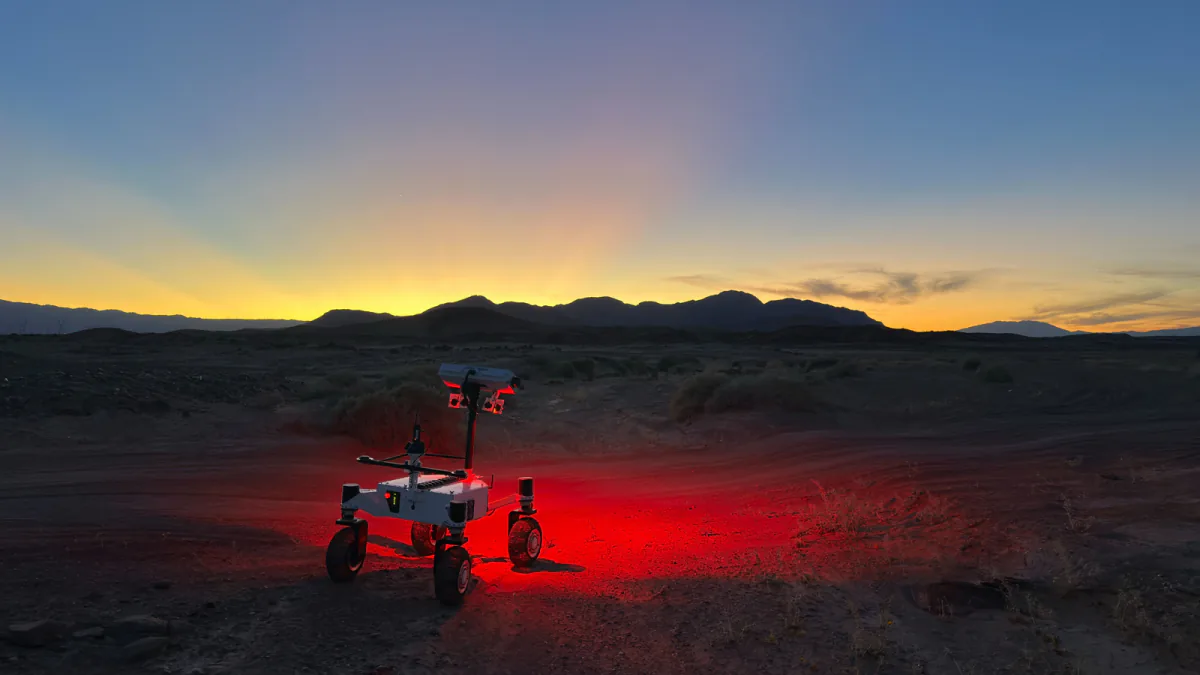
Four wheels that can change the rover's posture
ERNEST—short for Exploration Rover for Navigating Extreme Sloped Terrain—is a roughly 1.2-metre prototype with four steerable mesh wheels. Each wheel can be lifted, and two powered joints in the front gimbal let the rover shift weight and use movements such as wheel-walking, squirming and obstacle climbing.
A clutch lets the vehicle switch between active suspension and a passive mode that JPL describes as less capable on difficult terrain but more energy efficient. That trade-off is important: mobility is not free, and the public release does not quantify energy use across the two modes.
Training begins in a digital terrain
JPL used reinforcement learning in a high-fidelity simulator built from measurements of the real rover's hardware and terrain response. The team ran many simulations in parallel and says it could compress thousands of simulated test hours into a weekend.
After virtual training, the algorithms were tested in JPL's Mars Yard over sand ripples, rubble, steps and slopes. NASA says the rover completed multiple courses, but the release does not provide the training dataset, model architecture, intervention rate or a controlled comparison with alternative controllers.
Twenty-six kilometres in the Colorado Desert
During seven days in March 2026, ERNEST covered about 16 miles, or 26 kilometres, across 37 hours of drive time near Plaster City, California. JPL reports speeds up to 0.6 mph, or about 1 km/h, with minimal intervention.
The team also operated at dawn, dusk and night to explore lighting conditions relevant to large shadows near the Moon's poles. A terrestrial campaign can reveal endurance and autonomy problems; it cannot reproduce lunar gravity, vacuum, radiation, dust or temperature cycles.
The stated next step is integration
JPL's stated next objective is to combine decisions about when and how to use active suspension with longer-range navigation. The rover would then weigh whether to cross a manageable obstacle or route around a hazard.
The capability could inform future missions, but ERNEST is a research prototype and NASA/JPL's release does not announce a Moon or Mars flight assignment. The documentary photograph records the field test, not readiness for spaceflight.
Sources & Methods
LUMACTA NEWS separated the capabilities JPL demonstrated on Earth from future mission possibilities, and used the NASA Photojournal record for the exact campaign image.
- JPL — NASA Testing Advanced Capabilities for Moon, Mars Rovers — primary source
- NASA Photojournal — Desert Field Test With NASA Advanced Rover Prototype — primary image source
- JPL — Image Use Policy — image rights source
- NASA — Images and Media Usage Guidelines — image rights source