
A transit recorded from Mars
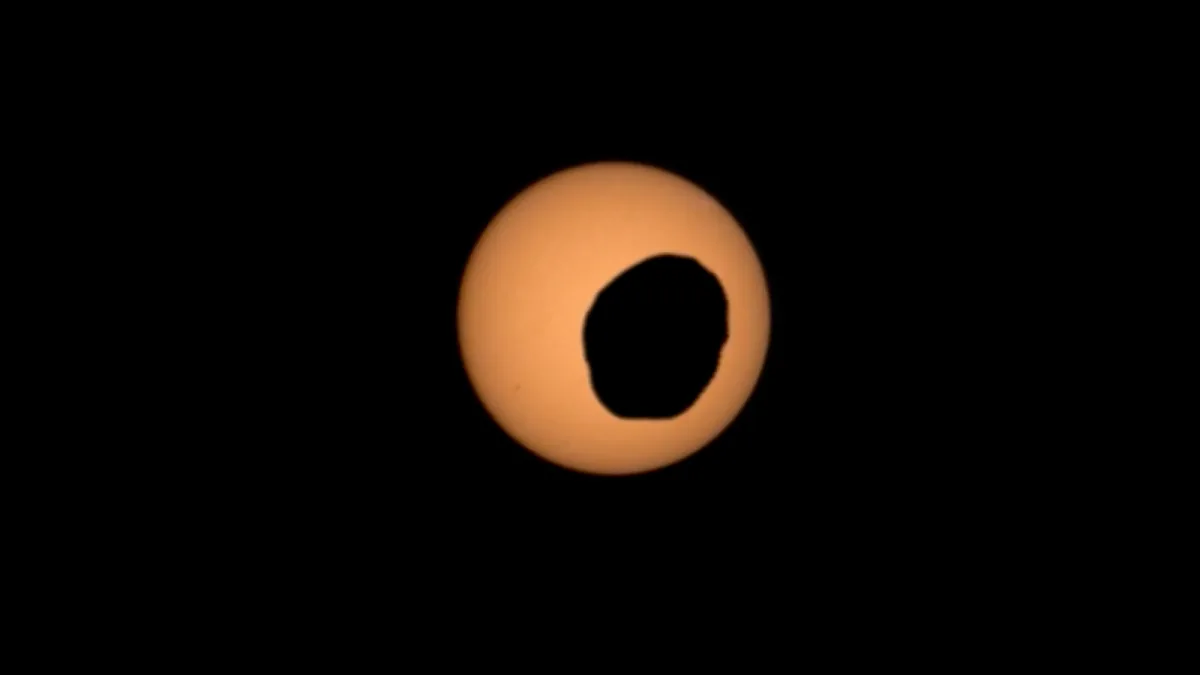
NASA's Perseverance rover used its Mastcam-Z camera system to record Phobos passing in front of the Sun on August 12, 2026, the 1,948th Martian day, or sol, of the mission. The official PIA26811 product includes a still frame and an MP4 animation made from the observation.
Phobos appears as a dark, irregular silhouette against the solar disc. This is a real observation made by an instrument on Mars; the published product should not be read as evidence of a particular transit duration or real-time playback speed.
The orange colour is part of NASA's presentation
NASA says the animation was tinted to simulate what a person would see from the Martian surface through protective solar-eclipse glasses. The orange colour is therefore a presentation choice, not an untouched true-colour view.
That treatment does not make the event synthetic. Mastcam-Z recorded Phobos crossing the Sun; NASA then applied the tint to the animation. The caption keeps those two facts together so the image is neither overstated nor mistaken for raw output.
Repeated transits turn timing into science
Perseverance has recorded several Phobos transits. NASA says that comparing the recordings helps scientists refine their understanding of the moon's orbit and how it is changing. An earlier NASA explanation adds that subtle orbital shifts can reveal how Mars's crust and mantle respond to Phobos's tidal forces.
The 2026 item does not publish a new orbital solution or quantify Phobos's inward drift. It also gives no transit duration, frame count, frame rate or stated playback speed. Those values should not be inferred from the animation.
A clear scientific chain of custody
The official record ties the observation to a named rover, camera system, mission sol and product identifier. Arizona State University leads Mastcam-Z operations, and NASA's Jet Propulsion Laboratory built and manages operations of the rover. LUMACTA NEWS therefore keeps the complete NASA/JPL-Caltech/ASU/MSSS/SSI credit with the image.
This is another observation in a longer record, not a first. NASA says Spirit and Opportunity made the first rover observations of Phobos transits in 2004, while Curiosity first recorded video of one in 2019.
Sources & Methods
LUMACTA NEWS checked the 2026 NASA and JPL records, matched the retained source master to both official downloads and used NASA's 2022 explanation only for the wider orbital-science context. The colour treatment stays in the caption, the full institutional credit is preserved and no timing or orbital value was calculated from the visible sequence.
- NASA Science Photojournal — Perseverance Captures Another Phobos Transit — primary source
- JPL — Perseverance Captures Another Phobos Transit — primary and image source
- NASA Science Photojournal — Mastcam-Z Captures a Phobos Solar Eclipse — primary background source
- NASA — Images and Media Usage Guidelines — rights source
- JPL — Image Use Policy — rights source